
Choosing a food trailer manufacturer is a business decision, not simply a product purchase. The right supplier should help you translate your menu, equipment list, service workflow and target market into a practical mobile kitchen. Before placing a B2B order, compare the factory’s manufacturing capability, customization process, quality controls, documentation and after-sales support—not only the trailer’s appearance or quoted price.
This checklist explains what to verify when comparing food trailer manufacturers. It is written for restaurant brands, distributors, event operators and entrepreneurs sourcing a custom food trailer for an overseas market.
1. Confirm what the manufacturer actually builds
Start by checking whether the company manufactures food trailers in-house or mainly resells finished products. An in-house manufacturer should be able to explain how it handles the trailer body, chassis, interior, kitchen installation, electrical work, water systems and final inspection. This matters because a custom trailer combines several systems that must work together in a limited space.
Greenfist presents itself as Shandong Greenfist Industry Co., Ltd., a manufacturer and exporter of custom food trailers, mobile food trucks and utility vending trailers. Its website describes factory-direct supply, customized sizes and layouts, kitchen equipment integration, international export support and after-sales service. Buyers should still request current factory information, product drawings and a clear scope of supply before ordering.
2. Compare the manufacturer’s customization process
A reliable customization process begins with your business requirements rather than a catalogue image. The manufacturer should ask about your menu, cooking methods, staff size, expected service volume, equipment list, storage needs, service windows and target operating market.
Ask whether the supplier can customize:
- Trailer length, width, height and internal layout
- Exterior color, wrap, signage and logo placement
- Service windows, doors, counters and storage areas
- Cooking, refrigeration, preparation and serving equipment
- Fresh-water, waste-water, electrical, gas and ventilation systems
- Trailer frame, towing components and local plug or voltage requirements
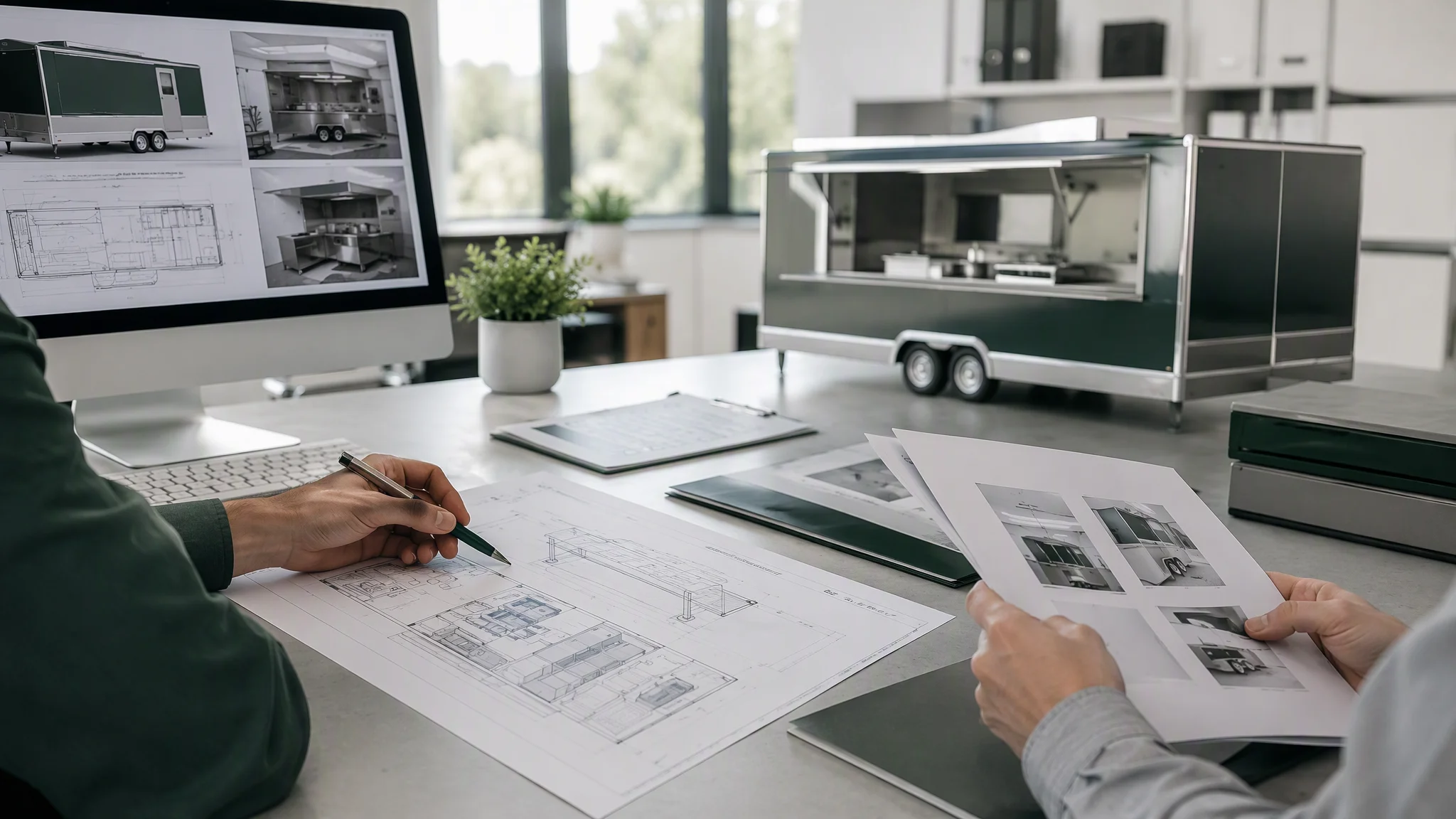
Before production, request a final layout drawing and a written equipment list. The drawing should show the location of major equipment, sinks, worktops, storage, service windows and utility connections. This gives both sides a practical reference for approval.
3. Evaluate the factory’s quality control process
Do not accept a general statement such as “high quality” as the only evidence. Ask what the factory checks, when each check takes place and what records or photos are available before shipment.
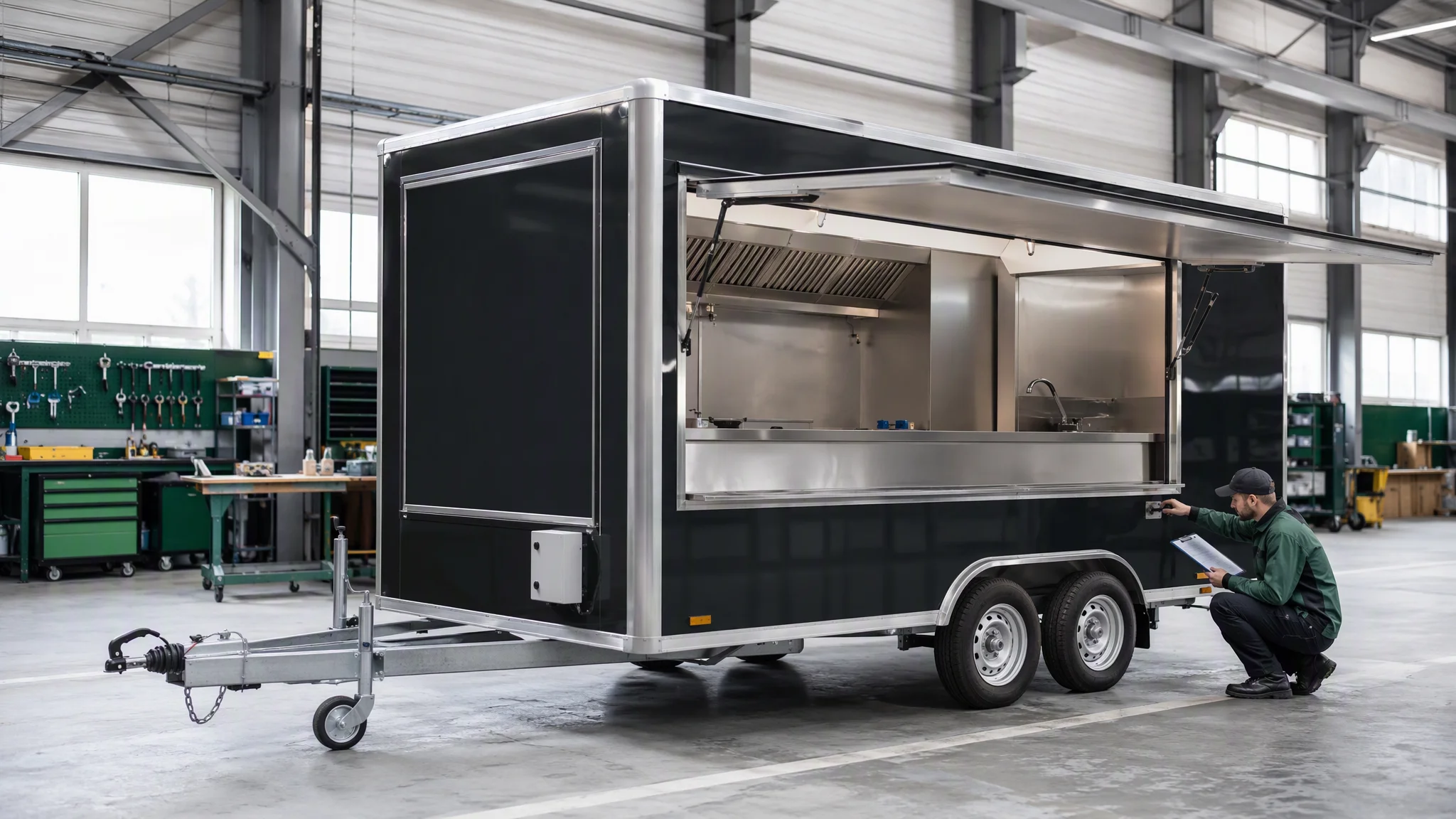
Greenfist’s quality-control page describes 28 tests across six groups: structural and material integrity, safety performance, waterproof and environmental performance, electrical systems, kitchen functions, and road simulation and durability. The listed checks include frame strength, body structure, anti-corrosion coating, brakes, lighting, sealing, insulation resistance, power load, gas leakage, ventilation, sink and drainage, towing performance and long-term durability.
When comparing suppliers, use a checklist such as the following:
| Area | Questions to ask the manufacturer |
|---|---|
| Structure | What materials are used for the chassis, frame, body and flooring? How is corrosion protection handled? |
| Kitchen | How are appliances, worktops, sinks and storage installed and tested? |
| Electrical | How are wiring, grounding, insulation, sockets and load capacity checked? |
| Water and gas | How are tanks, pipes, pumps, drainage and gas connections tested for leaks? |
| Road safety | What checks cover brakes, lights, reflectors, safety chains and towing stability? |
| Final inspection | Will the buyer receive inspection photos, a packing list and final configuration confirmation? |
For more detail, review the Greenfist food trailer quality-control process.
4. Verify certifications and destination-market documents
Certification requirements depend on the destination country, local authority, trailer configuration and installed equipment. A manufacturer should explain which documents are already available, which options can be supplied on request and which approvals must be completed by the buyer after import.
Greenfist’s certification page discusses ADR, CE, DOT and VIN topics, food-contact materials and ISO 9001. The page also states that 304 stainless steel is used for food-contact surfaces and that certification and compliance should support overseas commercial use. Buyers should request copies of the relevant documents and confirm the exact scope before using a certification claim in a purchase decision.
Ask these questions:
- Which certificate or document applies to this exact trailer configuration?
- Does the document cover the complete trailer, a component, the factory system or a specific market?
- What information is needed for local registration or inspection?
- Who is responsible for final approval after the trailer reaches the destination market?
- Can the electrical, gas, towing and sanitation configuration be adapted to local requirements?
Do not assume that one certificate automatically guarantees legal operation in every country, state, province or city. Confirm the final requirements with the relevant local authorities.
5. Compare the quotation line by line
A low initial quotation may not represent a lower total cost if important items are excluded. Ask the manufacturer to separate the quotation into trailer structure, interior materials, kitchen equipment, water system, electrical system, gas system, ventilation, exterior customization, documentation, packaging and shipping.
Your quotation request should include:
- Target country and port or delivery location
- Preferred trailer size and intended menu
- Equipment list with model, power and fuel requirements where available
- Required service windows, counters, sinks and storage
- Exterior color, logo and branding requirements
- Voltage, frequency, plug and towing requirements
- Requested documents and inspection requirements
- Quantity, target order date and packaging needs
This information gives the factory a better basis for a useful quotation and reduces the risk of comparing different scopes of supply.
6. Review production, inspection and shipping steps
Before ordering, confirm the sequence from design approval to delivery. A practical process usually includes requirement confirmation, layout approval, quotation and proforma invoice, deposit, production, inspection, balance payment, packing and shipment. The exact payment terms, production schedule and shipping time must be confirmed for the specific order.
Ask how the manufacturer communicates during production. Useful updates may include progress photos, equipment installation photos, test records, final measurements, packing photos and shipping documents. A written approval point before production helps prevent changes after fabrication has started.
Greenfist’s website describes a one-stop process from design and production to shipping and after-sales support. Buyers should convert this general promise into a written order checklist with responsible contacts, approval milestones and the documents to be delivered at each stage.
7. Check after-sales support and spare-parts communication
A food trailer is a working commercial kitchen. After-sales support should therefore cover more than a general warranty statement. Ask how the supplier handles equipment manuals, wiring diagrams, replacement parts, troubleshooting, maintenance questions and technical communication across time zones.
Also confirm which parts are standard, which are customized and which can be sourced locally. Keep a final equipment schedule and product manuals with the trailer records so your operators and service technicians can identify each system.
8. Use this final B2B comparison checklist
Before selecting a food trailer manufacturer, mark each item as confirmed, pending or not applicable:
- Factory identity and manufacturing scope verified
- Product size, weight and configuration confirmed in one final specification
- Menu, equipment list and workflow reviewed
- Layout drawing approved before production
- Materials and corrosion-protection method documented
- Water, electrical, gas and ventilation systems defined
- Quality-control and pre-shipment inspection steps agreed
- Destination-market documents and buyer responsibilities clarified
- Quotation includes all major equipment and delivery assumptions
- Production updates and approval milestones agreed
- After-sales contact and spare-parts process confirmed
Frequently asked questions
What should I send a food trailer manufacturer before requesting a quotation?
Send your menu, preferred trailer size, equipment list, service-window requirements, branding ideas, target country, electrical requirements, quantity and target purchase date. A layout sketch or reference image is also useful.
How do I know whether a food trailer supplier is a real manufacturer?
Ask for factory information, production photos, a description of the manufacturing process, quality-control records, current product drawings and a clear explanation of which work is completed in-house.
Can a food trailer be customized for different menus?
Yes, the layout and equipment can be planned around different menus such as coffee, BBQ, pizza, ice cream, burgers and other fast-food concepts. The correct size and utility systems depend on the actual equipment and workflow.
Does a certification guarantee that a trailer can operate everywhere?
No. Certification scope and local operating requirements vary by destination and configuration. Confirm the final vehicle, electrical, sanitation, fire-safety and business-permit requirements with the relevant local authorities.
What should I check before approving production?
Check the final drawing, dimensions, equipment list, materials, service windows, utility connections, logo placement, documents, inspection steps, packaging and the agreed change-control process.
How can Greenfist help with a custom food trailer project?
Greenfist describes its service as factory-direct manufacturing with custom sizes, layouts, exterior branding, kitchen equipment integration and export support. To discuss a project, visit the Greenfist contact page and provide your menu, target market, size and equipment requirements.
Conclusion
The best food trailer manufacturer is not simply the supplier with the most attractive catalogue image or the lowest first quotation. Choose a factory that can explain its manufacturing scope, convert your menu into a workable layout, document quality controls, clarify destination-market requirements and support you after delivery.
Greenfist’s website provides information about its food trailer product range, factory background, quality-control tests and certification topics. If you are comparing suppliers, prepare your menu and equipment list first, then request a custom food trailer discussion based on your actual business requirements.
Information about certifications, registration and local operation should be confirmed for the destination market and the final trailer configuration before purchase.